Showing posts with label Social Media. Show all posts

Wednesday, October 19, 2016

The C. Pharr Team Attends PRSA Dallas UnSummit: PR Deconstructed

Qaadir Abdul-Alim Muhammad & Megan Manning, 6th grade students at St. Phillip's School & Community Center share "The Power of the St. Phillip's Creed in Our Lives" at the 2016 PRSA Dallas UnSummit.
Recently, we had the chance to attend the PRSA Dallas UnSummit at the Granada Theater in Dallas. The annual communications summit was given a bit of a revamp and instead of multiple “PR breakout sessions” throughout the day, speakers took the stage every seven minutes for thought-provoking topics from “Communicating in Cuba” to “Counteracting Violence.” Not all the topics were focused on public relations, but each topic encouraged audience members to think outside the box, look at something through a different lens and/or inspire us to make a difference. Think TEDx for communications professionals. The speeches were filled with tweetable quotes. In fact, #PRSADallasUnSummit was a trending topic on Twitter. Below are a few of the most inspiring and thought-provoking quotes that were shared.
  •          “The bravest people aren't focusing on themselves. They focus on a purpose.” – Kimberly Davis, founder of OnStage Leadership, on “Unleashing Brave.”
  •          "The message that I send is not always the message that is received. Communication is the negotiation of meaning." – Christopher Salinas, Ph.D., senior lecturer and director, corporate communication and public affairs at Southern Methodist University, on “How failure makes you a better communicator.”
  •          “If you look at statistics about where employees want to work, they want to work for companies that do good.” – Suzanne Smith, founder and CEO of Social Impact Architects, on “CSR: Why it isn’t PR anymore.”
  •          “You can’t talk yourself out of a problem you behaved your way into.” – Jamaison Schuler, APR, senior director of corporate communications at Dean Foods, speaking on reputation and employee engagement in “Shadow Management.”
  •          “A river cuts through rock not because of its power, but because of its persistence. Run the mile you're in. Run your own race. It's a marathon, not a sprint. Persistence keeps us going.” – Raquel Daniels, chief strategy officer at OCGPR, on “Moving Diversity Forward.”
  •          "The key to a successful communication campaign is to unlock the imaginations of others." – Stephen Patrick, lead pastor of Trinity Parish, on the “Power of Presence: Discovering the dreams of our neighbors.”


The C. Pharr Team attends the 2016 PRSA Dallas UnSummit.

This post was contributed by Krystal Morris@KrystalNMorris

Share/Bookmark

Wednesday, December 2, 2015

PR Produced Great Content Before “Content Was Cool”

C. Pharr's Cynthia Pharr-Lee (middle) and Krystal Morris (far right) speaking to healthcare executives about PR strategies,techniques and case studies of effective and appropriate communication
integration with social media.

In the daily scramble to learn about the new, new digital thing, marketers sometimes overlook the powerful, but NOT new communications methods that can be invaluable contributors to an overall marketing strategy.

Specifically, I’m talking about traditional, B2B public relations and the powerful “earned content” that well executed PR programs can produce.

Long before digital marketers began to trumpet “content is everything,” effective PR campaigns have created the interesting and user-focused content that helps build brands and thought leadership. Such content can also empower marketing programs.

Today’s conversations about digital marketing stress the importance of credibility and transparency in connecting with customers. For many years, PR professionals have helped clients achieve well-placed publicity, speeches at respected conferences, and events that showcase expertise. These PR activities produce believable and impactful content that can be shared throughout a digital marketing program.

One of the strongest arguments for the power of earned content (especially publicity and speaking engagements) is that it yields de facto “third party endorsement” because the coverage isn’t bought and controlled by the subject. Rather, reporters or conference planners independently filter the information before deeming it credible and timely.  As a result, audiences have a higher degree of trust for earned content than paid advertising. Digital marketers who don’t consider “earned content” in their programs are failing to harness opportunities to connect with key audiences.

Current digital marketing practices also recommend omni-channel messaging, i.e., giving customers useful content, how and where they want it. For decades, PR professionals have been doing this by promoting strategic topics and selecting which speaker platform, event, publication and broadcast opportunities to pursue for clients. These standard planks in PR platforms have long provided a means of targeting audiences to give them content that interests them in the channel they prefer.

If anything is the “holy grail” in today’s successful digital marketing, it is the belief that “customer engagement” is the basis for measuring success. Indeed, digital consultancy Rosetta writes that “engaged customers are the best customers – they purchase 90 percent more frequently, spend 60 percent more per transaction, and deliver three times the annual value each year.”

A key strategy to achieve engagement is providing compelling information or experiences without asking for a sale. These approaches have been embraced by PR for decades. Editorial coverage of PR clients never includes call-to-action sales messages. Instead, it builds engagement by providing useful information and boosting awareness of expertise.  PR events, especially those that are cause-based or showcases of expertise, build relationships with targeted audiences through subjects of mutual interest, rather than hard-selling products.

Digital marketing strategists also recommend omni-channel communications, or consistency of messaging across all channels. If the PR team is involved in marketing strategy and aware of the marketing calendar, the credible content produced by PR can easily reflect the marketing messages used on other channels. Usually, the PR team will be responsible for coordinating executive speaking engagements, working with journalists in targeted media, planning events with key communities and helping plan and execute social media while scripting blogs, webinars and podcasts. With forethought, these activities can become integral parts of digital campaigns.

The meaty content produced by traditional PR programs and extended into social media can add real substance to digital campaigns. For example, including social share buttons/plug-ins when emailing content can drive readers to a landing page that offers interesting news articles. For speaking engagements, providing hashtags for the audience can encourage content sharing and assist in measurement.  Building tweets into presentations makes it more likely the speaker’s comments will be shared on social media…the possibilities are limitless.

In summary, there are powerful arguments for blending tried and true, traditional PR into newer digital marketing plans. Marketers who ignore opportunities to harness the power of PR’s earned content risk missing fuel which could fire up their campaigns.

This post was contributed by Cynthia Pharr-Lee, APR, Fellow PRSA. Connect with Cynthia on LinkedIn.


Share/Bookmark

Wednesday, September 9, 2015

Professor for a Day


I recently had the opportunity to speak with students in a social media class at the University of Texas at Arlington about finding and engaging your audience using social media. The class was attentive (they live-tweeted! Check out #PREL3320) and asked some great questions about responding to negative posts, what to post, when to post, and they even had some good questions about internships/resumes.

Whether you’re still a student or a seasoned PR pro, we could all use a little social media advice. Here are a few points I made to the class.      

Know your audience. Before you dive-in and adopt every social media tool out there, know who it is you’re trying to reach and adopt one or two platforms that your audience uses most. For example, B2B clients are likely to find their audience and influencers on LinkedIn and Google+, whereas B2C clients might find their audience on Facebook and Instagram.

Set a goal. When launching a client’s social media page, set clear goals and objectives before you make the page “live.” By having clear and measurable goals, you’ll know if you’re on the right track with your messaging and if you are effectively reaching your audience.

Use social media to tell your story. Whether you want to spotlight your corporate culture, recruit new employees, share product news and/or engage in thought leadership, social media can be a great channel to share your message. Just remember the social media “rule of thirds.” One-third of your content should focus on self-promotion, one-third should be spent commenting on trends/news/thought leadership and one-third should be personal interactions online and building your company’s brand. 

Focus on what works best. Visual content is typically the most engaging, so if your audience isn’t resonating with text-heavy messaging or links to events/articles, consider reducing your frequency of those types of posts.

For more on what we discussed, check out the #PREL3320 hashtag on Twitter.

This post was contributed by Krystal Morris. @KrystalNMorris.

Share/Bookmark

Tuesday, May 19, 2015

#EastDallasIs a Social Media Success! Six Tips to Increase Social Media Engagement

I recently had the chance to help plan and execute a social media strategy for a community project in East Dallas. The goal of the project was to build awareness and support for a new co-brand for East Dallas – “Lake & Garden District” – while rallying the entire community around enhancing the value of living in, doing business in, spending money in and playing in the East Dallas community. This viral campaign was a huge success and it all started with creating a Facebook and Instagram page to reach the large community of East Dallas. Additionally, we engaged with traditional media, hosted and attended community events and used yard signs as a way to create buzz.

The social media outreach for this community project was well received and gained attention from the community and the media almost immediately. In fact, the Facebook page went from zero to 935 fans in one week! The Lake & Garden District’s social media pages have been steadily growing since they launched on Feb. 6, 2015. To make your social media strategy a success, I've outlined a few tips below to grow your online engagement.  
       
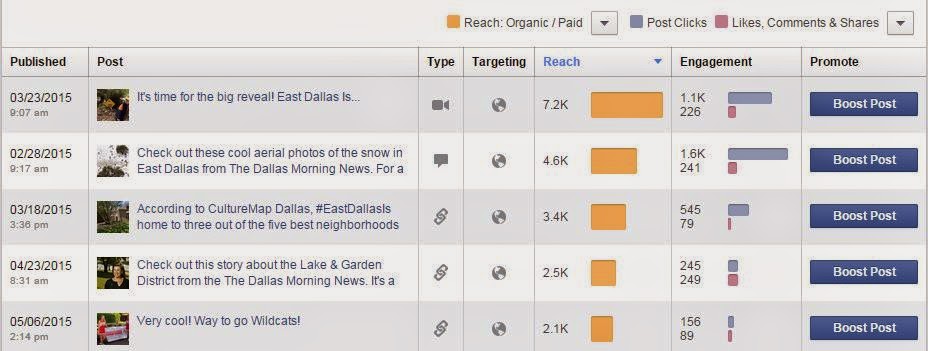
1. Get Visual – The reach and impressions for the Lake & Garden District Facebook page were highest when we posted fun visual content. Posts that had videos, photos and links to community news content were viewed and shared the most. Here are the top five posts from the Lake & Garden District Facebook page:

Our number one post to date with a reach of 7.2K+.
2. Sharing is Caring – Share posts, photos and videos from your followers. Social media is a way to have a conversation with your fans and followers. By liking and sharing content from others, you’re building a relationship and humanizing your organization. A few well-known and not-so-well- known organizations that are masters at this include @AnniesHomeGrown, @Netflix, @PizzaHut and @TacoBell.

3. Be Strategic – There are a myriad of ways to gather data about your posts and your fans to maximize the impact of your posts. Learn when your users are on social media and plan your posts around this schedule, posting on the most “popular” days and times when your fans are more likely to see and engage with your content.

4. Go Offline – This may sound counter-intuitive for a social media strategy, but engaging with your audience face-to-face is a great way to strengthen your relationships and build a fan base outside of social media. Whether you plan an event or simply encourage shoppers at your store to use a hashtag, having that positive in-person rapport translates to more fans online. 

5. Be Selective – It’s a rarity that a single company or organization needs to be on every social media channel. Consider your audience before you create a Twitter, LinkedIn, Pinterest, Instagram and Facebook page.  For the visually-heavy Lake & Garden District, we recommended starting with a Facebook and Instagram page because we knew we’d be creating photo contests, sharing hashtags and asking our audience to share images and stories of East Dallas.  Facebook and Instagram were the perfect tools for us and they continue to be the social media sites we utilize to reach our diverse audience. 


6. Create a Dialogue – As a way to not only reach, but engage our audience we encouraged fans to participate in the community project by sharing an #EastDallasSelfie or filling in the blank to this simple phrase: “East Dallas Is…” We encouraged our fans to share and post their “East Dallas stories” on our social media pages and on yard signs. The result was an overwhelmingly positive outpouring of support and community pride as our fans shared countless photos out and about in East Dallas along with numerous messages of what East Dallas means to them.

This post was contributed by Krystal Morris@KrystalNMorris

Share/Bookmark